
9/19/1907: Justice Lewis Powell's birthday.
The post Today in Supreme Court History: September 19, 1907 appeared first on Reason Magazine.
Read Entire Article Here: Reason Magazine Articles
via IFTTT

9/19/1907: Justice Lewis Powell's birthday.
The post Today in Supreme Court History: September 19, 1907 appeared first on Reason Magazine.


We are at the dawn of a golden age of biosciences, characterized by massive leaps in molecular biology. Breakthroughs in precise gene editing, mRNA vaccines, targeted cancer treatments, and more are transforming biomedicine.
Retatrutide, a new diabetes and weight loss medication that targets three different receptors in the brain and body, is even more potent than earlier GLP-1 medications. In preliminary trials, the drug enabled people to lose an average of 70 pounds over 80 weeks. Millions of Americans with diabetes and/or obesity have benefited from GLP-1 medications, and the obesity rate for adults has begun declining largely due to their advent. GLP-1 drugs also reduce the risk of heart attacks, reverse fatty liver disease, slow the progression of chronic kidney disease, and effectively treat sleep apnea. Although retatrutide has not yet been reviewed, let alone approved, by the Food and Drug Administration (FDA), black market versions are popular among biohackers.
Lipoprotein(a), or Lp(a), is an especially dangerous kind of cholesterol that triples the risk of a heart attack. Your genes largely determine your Lp(a) level. Cardiologists have known for decades that around 20 percent of Americans are at risk of elevated Lp(a), but they have not offered to test their patients. Why? Because doctors could offer no treatments for the condition. Never mind that patients might want to know their risk for their own reasons, such as career planning. In April, the cadre of medical paternalists finally recommended that patients take a one-time blood test to determine their Lp(a) levels. Fortunately, treatments to lower Lp(a) may be available soon. Preliminary clinical trials show that small interfering RNA drugs shut down Lp(a) production in the liver, reducing levels by 80 percent to 94 percent.
The FDA willing, a powerful new mRNA influenza vaccine providing broad protection against various strains of the virus should be available during the next flu season. More than 620,000 Americans are estimated to be infected by Lyme disease each year. But thanks to trial lawyers, Americans have not had access to a vaccine against the tick-borne illness. That could soon change: This year, Pfizer and Valneva reported that their new vaccine is 70 percent effective in preventing Lyme disease. So far, 91 million people worldwide have been infected with HIV, and 44 million have died of the disease. Researchers at the La Jolla Institute for Immunology and the Scripps Research Institute report that they have developed a vaccine that induces broadly neutralizing antibodies against HIV in primates. A preliminary human trial began earlier this year.
Back in 2009, I paid 23andMe $1,000 for a genotyping test that analyzed about 555,000 single nucleotide polymorphisms (SNPs). The test captured about 5 percent of the common human SNPs. Using the data, 23andMe compiled health predisposition reports, carrier status, and ancestry insights. I just paid sequencing.com $399 to sequence my entire genome. The company is analyzing my genetic data against more than 15,000 diseases, rare conditions, traits, and medication reactions.
Highly effective vaccines targeting cancer-inducing pathogens—such as HPV and Hepatitis B—have been available for decades. Researchers are now developing therapeutic mRNA vaccines to prime patients' immune systems to attack their cancers. A preliminary 2026 study reported that seven of eight patients who responded to a pancreatic cancer vaccine were still alive four to six years after surgery. More excitingly, researchers are beginning to develop vaccines that trigger a preventative immune response to common cancer-causing mutations before tumors develop. In a preliminary preventative vaccine trial, none of the patients with a genetic predisposition or worrisome cysts developed pancreatic cancer.
In May, Paterna Biosciences reported that it had grown functional human sperm entirely outside the body. Paterna used the lab-grown sperm to successfully fertilize human eggs. In June, the biotech company Conception announced that its researchers had turned blood cells into mini ovaries that contain millions of future human egg cells. That same month, a team of Columbia University researchers detailed how they used a precise version of CRISPR genome editing to correct a specific mutation in early-stage human embryos. (Not surprisingly, the achievement provoked bioethical warnings that rich people would start combining the tech with in vitro fertilization to optimize their children.)
Getting older makes you more prone to all kinds of maladies. So why not become younger? Considerable research is focused on Yamanaka factors, a set of four proteins discovered by Nobel laureate Shinya Yamanaka that reprogram old cells into youthful stem cells. Life Biosciences is launching a clinical trial deploying three of the Yamanaka factors to restore sight by resetting old, damaged cells to more youthful patterns of gene expression. Several other startups, including Altos Labs, Retro Biosciences, and Rejuvenate Bio, are pursuing this route to increased longevity and health through cellular rejuvenation. More adventurous (reckless?) anti-aging pioneers might consider traveling to biotech startup Minicircle's clinic in the Honduran charter city of Próspera for Klotho injections. The company's gene therapy boosts the production of the Klotho protein, which has been shown to improve physical and cognitive health and extend lifespan in mice.
As exciting as this short list of biomedical advances is, I am asking everyone involved to please hurry. None of us is getting any younger.
The post Cancer Vaccines, Anti-Aging Treatments, and 5 Other Exciting Biomedical Advances appeared first on Reason Magazine.
The post Open Thread appeared first on Reason Magazine.
After the largest massacre of Jews since the Holocaust, thousands of college students marched through the streets chanting, "From the river to the sea, Palestine will be free." Most of them likely had no clue which river and sea were at issue. And they probably also gave zero thought to what it would mean for Palestine to be "free." The college students likely never heard the far more accurate version of the chant in Arabic, which translates to "From the river to the sea, Palestine will be Arab." In short, the only Jewish state in the world would cease to exist, and all Jews would be expelled.
A recent poll relates sentiments among Palestinians towards a Jewish state:
West Bank Palestinians are split on whether Israel has a right to exist, and whether its existence could be brought to an end at some point, according to a survey conducted by Tel Aviv University's Institute for National Security Studies.
The poll finds that 41% of respondents say Israel has a right to exist, compared with 46% who say it does not. In a separate question, 42% say they believe it would be possible to bring about the end of Israel's existence, either in the near or distant future. Conversely, 32% say ending Israel's existence is impossible. . . .
No proposed political framework for resolving the conflict receives majority support. Twenty-seven percent favor a two-state solution; 22% support a single binational state with full equal rights; 26% favor a Palestinian state "from the river to the sea" — encompassing all of what they consider "historic Palestine" — with no permanent Jewish presence; and 17% favor a Palestinian state throughout the entire territory in which Jews would be permitted to live as citizens or residents.
I don't pretend to know how to resolve the situation, but Americans who seek to opine on the subject should at least know how Palestinians would respond if their land was "free."
The post Nearly 50% of West Bank Palestinians Says Israel Does Not Have A Right To Exist appeared first on Reason Magazine.
The post Open Thread appeared first on Reason Magazine.
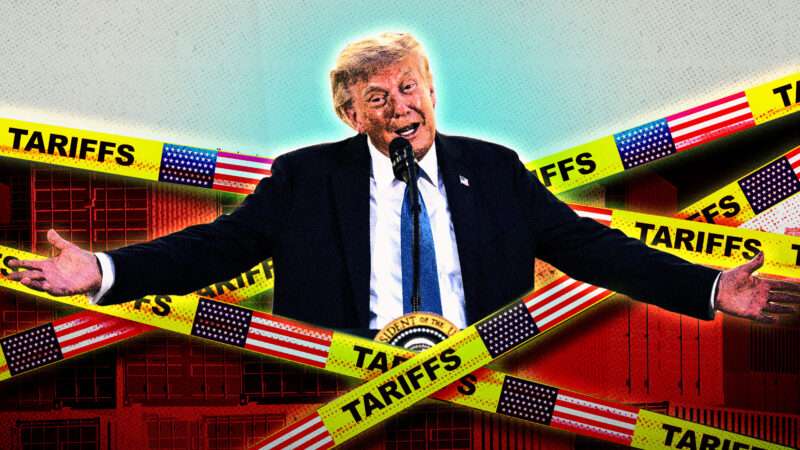
President Donald Trump is trying to "shift the exercise of core tariff authority from Congress to the Executive Branch," three former trade officials warn in a brief they filed last week. If that sounds familiar, it's because Trump has attempted something similar twice before, only to be rebuffed by the courts.
This time around, the brief notes, Trump is relying on Section 301 of the Trade Act of 1974, claiming "a sweeping power to impose broad, economy-wide tariffs untethered from the statute Congress enacted." That assessment is especially noteworthy because the brief's authors, who are urging the Court of International Trade (CIT) to reject Trump's power grab, were intimately involved in drafting and enforcing Section 301.
One of them is Alan Wm. Wolff, who directed the Treasury Department's Office of Multilateral Trade Negotiations and served as general counsel for what is now the Office of the U.S. Trade Representative (USTR) during the Nixon and Ford administrations. Wolff played a leading role in drafting the Trade Act and wrote the original version of Section 301.
Wolff is joined by Carla Hills, the USTR under then-President George H.W. Bush, and Warren Maruyama, who was a USTR lawyer during the Reagan administration and the office's general counsel during the George W. Bush administration. Both have extensive experience in implementing Section 301, which authorizes the USTR to impose tariffs in response to a foreign "act, policy, or practice" that is "unreasonable or discriminatory' and "burdens or restricts United States commerce."
Section 301 "was enacted to address specific unfair trade practices by individual U.S. trading partners," Wolff et al. note. But the Trump administration views the provision as a license to impose sweeping tariffs on trading partners that account for nearly all U.S. imports, under the pretext that they have failed to "impose and effectively enforce a prohibition on the importation of goods produced with forced labor."
Contrary to the statute's requirements, the findings underlying that determination do not specify how each of the targets has fallen short or how their supposed failures burden U.S. commerce. Nor has USTR Jamieson Greer explained why the tariffs can be expected to ameliorate the problem he claims to be addressing.
The upshot of these "often sham 'investigations,'" Wolff et al. note, is a tariff regime strikingly similar to the one Trump tried to impose last year under the International Emergency Economic Powers Act (IEEPA), a 1977 law that does not mention import taxes and had never been used to impose them. Last February, after the Supreme Court ruled that IEEPA does not authorize tariffs at all, Trump switched to Section 122 of the Trade Act, which the CIT said he had improperly invoked.
"The Section 301 tariffs appear to be a thinly disguised pretext for reimposing the President's IEEPA tariffs under the guise of dealing with forced labor," Wolff et al. say. As they see it, "nothing in the statute authorizes [the] USTR" to "justify tariffs of unprecedented breadth" by aggregating "dozens of separate investigations" and setting "a novel standard that foreign countries have not in the judgment of the USTR met."
The Trade Act "imposed clear substantive and procedural limits on each tariff authority" it delegated, the brief notes. "It is not at all credible that Congress simultaneously conferred, by implication, an unlimited tariff power through Section 301, administered by a cabinet official, without any indication in the statute or legislative history that it intended to do so."
By asserting "an effectively boundless Section 301 authority through the aggregation of numerous investigations," Wolff et al. say, Greer "exceeds the limits established by Congress and upsets the constitutional allocation of trade powers." But what do they know?
A thing or two, suggests the Liberty Justice Center, which filed one of the lawsuits challenging Trump's tariffs. "The people who know Section 301 best," it says, "are telling the [CIT] that the administration is using the statute in a way Congress never designed it to be used."
© Copyright 2026 by Creators Syndicate Inc.
The post Former Trade Officials Explain Why Trump's Section 301 Tariffs Are Illegal appeared first on Reason Magazine.
An excerpt from the longish opinion today by Judge Rudolph Contreras (D.D.C.) in Streever v. Mullin:
Americans have long voiced their displeasure with their government. The Declaration of Independence itself is a list of grievances between Americans and the British government. And Americans have not always indulged in the elevated prose of the Declaration. Government officials have long endured "vehement, caustic, and sometimes unpleasantly sharp attacks."
Today is no different. Plaintiff David Streever expressed his displeasure with the United States Immigration and Customs Enforcement ("ICE") by sending a three-paragraph email to the agency's Acting Director, Defendant Todd Lyons. Mr. Streever compared Acting Director Lyons to an infamous Nazi and predicted that he would become "a sad, despised man who eats himself alive with shame at [his] own pathetic weakness."
What is different is how the government responded in this case. ICE dispatched agents to Mr. Streever's home and delivered to him a "WARNING NOTICE." The notice threatened him with prosecution if he did not "discontinue" his criticism of ICE. Because that notice likely violates Mr. Streever's First Amendment right to free speech, the Court will grant, in part, Mr. Streever's motion for preliminary injunction, enjoining Defendants from relying on the Warning Notice, issuing similar threats, or making good on the threats in the Warning Notice…..
Mr. Streever was outraged by the deaths of two Minnesotans, both of whom were shot by ICE officers in January 2026. To register his anger, Mr. Streever sent ICE's Acting Director, Todd Lyons, a three-paragraph email titled "What's next." The email read as follows:
You are a monstrous human being and will go down in history as America's Reinhard Heydrich, the butcher.
The way you are protecting the obvious execution in Minnesota, even as we see the videos, will lead to your downfall. Even Trump will turn on you before the end, and you will be a sad, despised man who eats himself alive with shame at your own pathetic weakness.
You will never know peace. You will seek to lose yourself, to escape the burden of knowing the truth about yourself. But wherever you go, you will find yourself. You will torment yourself until your last day on Earth.
Mr. Streever's January 26, 2026, email came during an uptick in threats to ICE officers. According to the Assistant Director of the Office of Professional Responsibility ("OPR") Investigations within ICE, Brent Goodwin, "ICE has experienced a 946% increase in threats against ICE officials" between fiscal years 2024 and 2025. "In [fiscal year] 2025, ICE OPR investigated approximately 66 potential threats against senior leaders."
At some point after ICE received Mr. Streever's email, it "was forwarded to OPR because it was determined that the email had potential threatening undertones to ICE personnel, potentially presenting a safety concern." Because "ICE OPR did not have any information about Mr. Streever … OPR determined that it needed to conduct an ICE investigation." … As part of their investigation, now five months after Mr. Streever sent his email, Agents Henry and Brodie traveled to Mr. Streever's home in Rochester, New York, to speak with him. But Mr. Streever was not home. He was off traveling in Europe. So the agents spoke with Rev. Hilary Streever, Mr. Streever's wife. They told her that Mr. Streever "'may or may not have' sent an email to Todd Lyons, threatening Lyons" and that they "needed to talk to [Mr.] Streever."
The agents then handed Ms. Streever a "WARNING NOTICE." The notice stated at the top: "YOU MAY BE IN VIOLATION OF FEDERAL LAW." It then explained:
U.S. Immigration and Customs Enforcement (ICE), Office of Professional Responsibility (OPR) is responsible for protecting ICE, its employees, and its facilities against internal and external threats. OPR is responsible for enforcing crimes against the United States as authorized under Title 19 of the U.S. Code and as designated by the Secretary of Homeland Security, including criminal investigations into threats made against ICE personnel. OPR has identified an email sent to Acting ICE Director Todd Lyons, which it has reason to believe may constitute a violation of Title 18 of the U.S. Code. Accordingly, OPR is requesting that you promptly remove and/or discontinue the aforementioned behavior.
This Notice officially informs you that it is unlawful to threaten to assault, kidnap, and/or murder a federal official or that federal official's immediate family member with the intent to impede, intimidate, and/or interfere with the federal official's duties or retaliate against a federal official due to the performance of their duties. 18 U.S.C. § 115(a). You are further advised that knowingly making restricted personal information about a covered person, or their immediate family member, publicly available with the intent to threaten, intimidate, or incite the commission of a crime of violence against the person; or with the intent and knowledge that the restricted personal information will be used to threaten, or intimidate, or facilitate the commission of a crime of violence against that person violates federal law. 18 U.S.C. § 119. Violations of these or related laws could subject you to both federal and state prosecution.
OPR has documented the delivery of this Notice to you. Receipt of this Notice will be taken into consideration, should you continue to be involved in any criminal activities described above. If you wish to discuss this Notice and its contents further, please contact the undersigned Special Agent who served you with this Warning Notice or the local OPR field office….
At the end of the month, Agent Henry "wrote a report of investigation to serve as a closing report summarizing the investigation." "With its investigation closed," OPR represents that it "does not contemplate any further investigation into Mr. Streever regarding his January 2026 email to Lyons."
But no one told Mr. Streever that the investigation was closed. Assuming he was still under investigation, Mr. Streever sued Defendants on July 6, 2026. The organization representing Mr. Streever then posted on social media touting Mr. Streever's lawsuit. A DHS social-media account responded, explaining that "ICE investigates all credible threats towards its employees and officers, including threats to the ICE Director. As a matter of policy, we do not comment on any ongoing investigations." The post closed by emphasizing that "ANYONE who assaults or threatens our law enforcement officers will face the consequences." A DHS spokesperson gave the same answer to a reporter for National Public Radio, although without the threat of future consequences….
The court concluded that plaintiff had standing to challenge the Warning Notice, which "provides a continuing injury over which Mr. Streever has standing to sue," and concluded the Warning Notice likely violated the First Amendment:
Defendants wisely do not contest that Mr. Streever's January email constitutes protected expression or that similar speech would be protected. Mr. Streever's email addressed salient political decisions to a government official, an arena where the First Amendment's speech protections reach their "zenith."
More importantly, the email does not contain a physical threat. The email registered displeasure with Acting Director Lyons's official conduct, forecasted that the Acting Director will lose favor with the President, and warned that the moral weight of the Acting Director's actions will haunt him in the future. Although Mr. Streever's email was not kind, and may not have been particularly productive, it was a far cry from a "[t]rue threat[ ] of violence" sufficient for the email to shed its First Amendment protections….
Defendants maintain[, however,] that a mere investigation is not coercive…. [But] Agents Henry and Brodie went beyond mere investigation—especially when they issued the Warning Notice. When distinguishing "between permissible attempts to persuade and impermissible attempts to coerce," courts must consider whether the conduct, "viewed in context, could be reasonably understood to convey a threat of adverse government action." NRA v. Vullo. Some useful indicia include the government's tone, whether the government could take action against the plaintiff, the perception of a threat, and whether the government references adverse consequences.
Applying this standard, Mr. Streever is likely to succeed in showing that Defendants engaged in coercion, rather than persuasion. OPR did not ask kindly if Mr. Streever would tone down his rhetoric. It dispatched two agents to his home for an unannounced visit where they delivered a "WARNING NOTICE." Although that notice "request[ed]" that Mr. Streever "discontinue" his political expression, it characterized that political expression as potentially violating federal law which "could subject [him] to both federal and state prosecution." The notice practically shouts that Mr. Streever may be prosecuted if he continues to engage in his political speech. Even if Defendants' benign explanation of the notice were plausible, Mr. Streever "reasonably understood [the notice] to convey a threat of adverse government action," namely prosecution….
[T]he Court finally determines nothing in this decision, and it does not award
Mr. Streever, even preliminarily, all the relief he seeks. The Court merely orders the temporary vacatur of the Warning Notice and preliminarily enjoins Defendants from issuing similar threats to Mr. Streever or from making good on the threats in the Warning Notice while the case continues. Failure to do so would allow the censorship of Mr. Streever to endure during the case, something this Court would be largely unable to remedy afterward and which would undermine Mr. Streever's position while the case proceeds.
In fact, allowing the continued censorship of Mr. Streever during these proceedings could be tantamount to defeat for Mr. Streever depending on how long final resolution takes because Mr. Streever alleges a desire to speak out about a political issue that is particularly salient now but might not be as critical a year or two in the future. Moreover, the immediate interim period may be of particular importance to Mr. Streever because the speech he seeks to engage in is political, and there is an upcoming federal election just a couple of months away. Thus, even under the Third Circuit's understanding, a narrow preliminary injunction is appropriate here to stave off censorship during the election cycle and while the issue on which Mr. Streever wishes to speak is most salient…..
The Court is unsure whether it could grant Mr. Streever an injunction covering all future investigations into his protected speech. Generally, courts enjoin a particular investigative demand, rather than enjoining an investigation itself….
For one thing, Defendants argue that they have a legitimate interest in investigating even threats that do not rise to the level of a prosecutable offense as due diligence to ensure that no future criminal act will occur, even if they do not intend to charge the speaker with a criminal threat. Moreover, law enforcement officers—like the rest of us—are generally free to approach a home, knock on the door, and briefly wait for a response, as Agents Henry and Brodie did, regardless of whether they are investigating a crime. Homeowners are likewise free to refuse to speak with law enforcement.
Because the Court is unsure whether it is appropriate to preliminarily enjoin a swath of potential future investigations, the Court declines to do so here…. The Court will therefore focus its injunction on the Warning Notice and the January email. The Court will, for the time being, vacate the Warning Notice; it will preliminarily enjoin Defendants from relying on the Warning Notice and Mr. Streever's January email in future prosecutions and investigative demands; and it will preliminarily enjoin Defendants from issuing similar warnings to Mr. Streever that suggest he cannot engage in non-threatening criticism of the government….
Adam Steinbaugh, Hannah Abbott, Jeffrey Daniel Zeman, and JT Morris (Foundation for Individual Rights and Expression) represent plaintiff.
The post Warning Notice to Man Who Sent Critical E-Mail TO ICE Acting Director Likely Violated First Amendment appeared first on Reason Magazine.

The European Union has placed ChatGPT, Reddit, and Roblox under stricter rules after all three passed the threshold of 45 million average monthly users in the E.U. Under the Digital Services Act (DSA), they must now assess and reduce risks involving illegal content, children's safety, users' mental and physical well-being, fundamental rights, elections, and public security. ChatGPT is the first AI chatbot to be subject to the DSA and is being treated as a Very Large Online Search Engine, while Reddit and Roblox are classified as Very Large Online Platforms. The companies will face greater transparency requirements and government oversight. The move is part of the E.U.'s increasing oversight of large tech companies.
The post Brickbat: E.U. Blues appeared first on Reason Magazine.
The post Open Thread appeared first on Reason Magazine.

Earlier tonight, the Supreme Court, in a 7-2 ruling, refused to stay a lower-court decision blocking the Postal Service's policy implementing Donald Trump's executive order intended to curb mail-in voting. I have previously written about the First Circuit ruling in this case, and about how Trump's order is a blatant assault on federalism and separation of powers.
As is often the case with "shadow docket" decisions, the majority opinion offers almost no analysis. But they do state that "[t]he Government is unlikely to succeed on the merits of its challenge to the District Court's preliminary injunction [against the USPS policy]." That indicates they believe that Trump's policy is indeed illegal, likely for reasons similar to those outlined by the district court and the First Circuit.
In a concurring opinion, Justice Brett Kavanaugh states that he thinks "there is at least a fair prospect that the final rule falls within the Postal Service's statutory authority," but that the district court was still right to block it, under the Administrative Procedure Act "because state and local election officials do not have sufficient time to reasonably implement the rule before the elections."
In a dissent joined by Justice Thomas, Justice Samuel Alito argues that the policy is within the authority of the USPS, but bases it on statutes that nowhere mention altering mail-in ballot election rules, but only authorize USPS to make rules for the collection and delivery of the mail. Alito largely ignores the massive federalism and separation of powers issues arising from conflating the latter with the former. In addition, as the district court and the First Circuit noted, twisting this language into a sweeping power to override state mail-in ballot rules raises serious "major questions doctrine" issues.
As the District Court noted, Congress must speak clearly when delegating a "highly consequential power" to the executive, and the power to rewrite state election rules is pretty obviously highly consequential. and, to put it mildly, the statutes granting authority to the USPS come nowhere near clearly giving it such power. Indeed, they don't even mention voting rules.
To put it a different way, inferring a power to regulate mail-in voting from a power to make rules necessary for the delivery of the mail is a classic example what Justice Antonin Scalia famously called "hid[ing] elephants in mouseholes," warning courts to avoid assuming Congress did that. The Trump administration claims there is a truly enormous elephant in a very tiny mousehole here. The Court was right to reject that position.

The post Supreme Court Refuses to Block Lower-Court Ruling Against Trump's Mail-in Ballot Executive Order appeared first on Reason Magazine.

For much of human history, moving house has been a death-defying ordeal. When pioneer Loren Hastings reached Portland, Oregon, in 1847, he looked back on the Oregon Trail and called it a "graveyard."
Today, you can pack up everything you own and move anywhere in the country without risking life and limb. Convenience has made nomads of us all, turning a tedious and life-threatening experience into one that requires minimal time and effort.
It does not matter whether you live in a Texas Hill Country ranch house or in a 500-square-foot, one-bedroom apartment in Washington, D.C. Thanks to the click-and-tap world of same-day delivery made possible by capitalism, it has never been easier to pull up stakes and move to new digs. Here are some essentials that can simplify any move.
Moving Truck

Don't have your own vehicle suitable for moving your stuff? U-Haul has a truck for every home size and budget. You can rent whichever truck fits your needs right from your phone without ever entering a store. Need boxes, mattress covers, or furniture pads? Click, click, click—all in the same app.
Cordless Vacuum

If you're like me, you won't bring boxes or bags into the new place until every surface has been thoroughly cleaned, starting with the floors. The Jellypig can run for more than an hour per charge, and its cordless nature means you don't have to unplug and replug it every time you move to a different part of your home. It's easy to store and comes with a smart screen that lets you adjust the suction power for those gnarly dust bunnies the last tenant left behind.
Furniture Repair

It's almost inevitable. While hauling a bulky piece of furniture, you scuff its surface against the wall and expose its rough wood core. Grab some Match 'N Patch Wood Grain Repair Tape and fix it right up. With a variety of sizes and colors, you can cover virtually any accidental abrasion.
Cleaning Cloths

When it comes to wiping down surfaces in your new home, there is nothing better than a good microfiber rag. This polyester material, invented by Japanese scientist Miyoshi Okamoto in 1970, has become the go-to fabric for cleaning, thanks to mass manufacturing and global competition. Grab a pack of 24 microfiber towels for just $10 and keep your new place dust-free.
Command Hooks

Hanging your belongings can reduce the need for additional furniture. Command Hooks are an easy option. There is no need for drilling or hammering; you just peel and press. And the hooks are surprisingly durable: I've used the same ones in three different apartments over the course of five years. As a bonus, they're renter-friendly.
Mattress

Gone are the days of going to the mattress store and hauling your purchase home on the top of your car. Browse an expansive range of options on Wayfair. Once you find your dream mattress, arrange to have it shipped to your new home within a day or two. For a small fee, a Wayfair partner will even pick up your old mattress and set up the replacement.
Tool Set

Moving means hanging up artwork, assembling furniture, and fixing the occasional jiggly door handle. This 39-piece tool set from Cartman has everything you need for quick jobs—no need to wait for your overworked maintenance staff.
Plant Stand

Keeping your plants on the window sill made sense when they were limited to a possibly dead orchid and that tiny succulent you got at the office white elephant party. But your collection of plants has grown, and now they're hard at work purifying the air in your new home. They deserve a home, too, so check out Etsy's wide variety of artisanal plant stands.
TV Mount and Taskrabbit
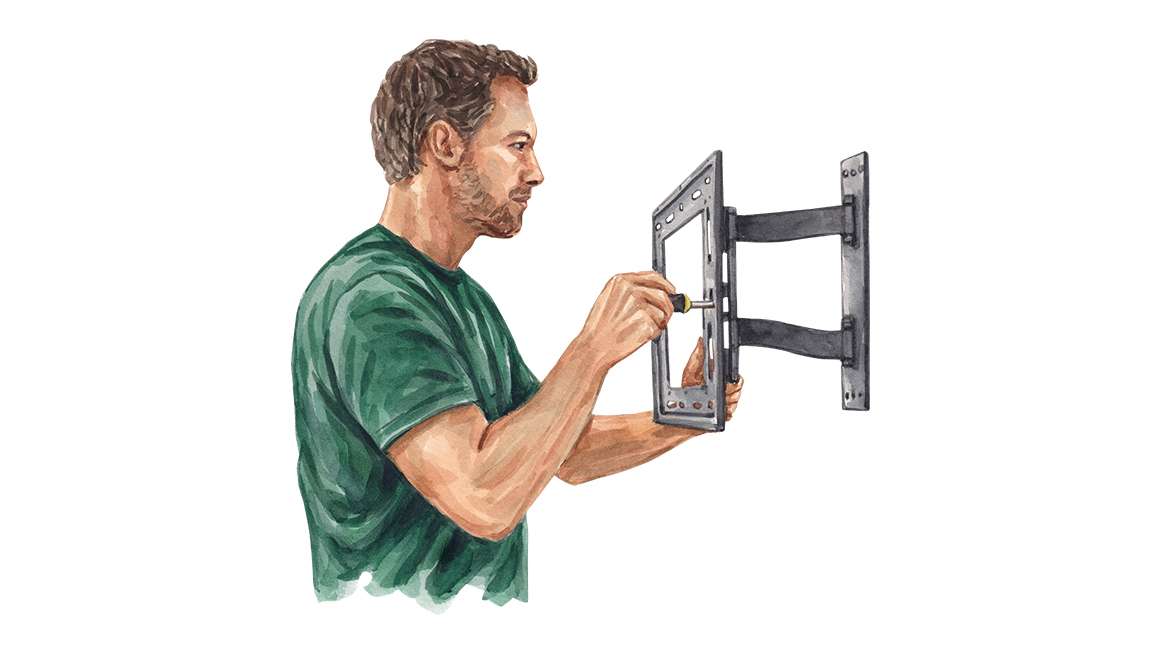
If you're a space maximizer like me, you are probably hanging your TV instead of taking up room with a stand. You may be better off leaving the mounting to a professional—by which I mean a guy on Taskrabbit with at least a 4.5-star rating and at least 10 completed tasks.
Grocery Delivery

The moving is all done, but your fridge is empty. Enter Instacart, a modern alternative to the arduous grocery store trip. If you thought ahead, you placed your order before you put the first box in the U-Haul. With same-day and two-hour delivery options, your groceries can arrive at your new home even before you do.
The post Moving Soon? Here Are 10 Modern Conveniences That Will Make It Easier. appeared first on Reason Magazine.
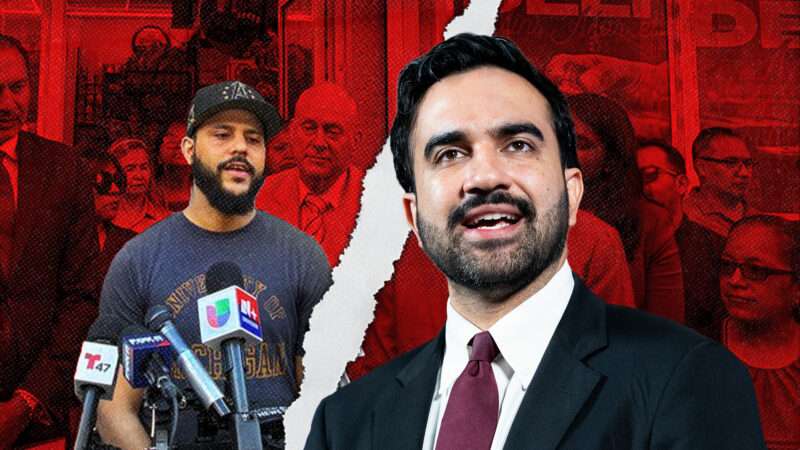
Immigrant-owned small businesses in East Harlem that spoke out against Mayor Zohran Mamdani's plan for city-owned supermarkets say they are suddenly receiving more New York City sanitation fines than normal, and some believe it is retaliation. Shop owners report receiving multiple tickets, sometimes for trash that isn't even theirs, costing hundreds of dollars, while others have faced penalties as high as $1,000. The Multicultural Business Coalition recently sued the city over the supermarket plan because it fears the government stores will unfairly hurt local shops, and it claims the fines increased right after members started going door-to-door for support. The Sanitation Department says it issues cleanliness tickets all over the city and is only trying to keep streets clean.
The post Brickbat: Keeping the Peace appeared first on Reason Magazine.
The post Open Thread appeared first on Reason Magazine.

I have previously written about Trump's harmful and illegal imposition of Section 338 tariffs against various Canadian imports, and his recent expansion of those actions to include categorical bans on some Canadian products. In this post, I will explain how the legal case against these actions is bolstered by the major questions and nondelegation doctrines.
Section 338 was part of the infamous Smoot-Hawley tariff act of 1930, which gravely exacerbated the Great Depression. There is a strong case that Trump's Section 338 tariffs are illegal both because Section 338 (which has never been used previously) was superseded by later legislation, and because Trump's tariffs do not meet the textual requirements of Section 338. On the former point, see this 2025 Volokh Conspiracy guest post by Philip Zelikow of the conservative Hoover Institution. On the latter, see this excellent guest post by Georgetown University trade policy experts Peter Harrell and Jennifer Hillman.
But assume it is unclear whether Section 338 has been superseded and whether the Trump tariffs on Canadian imports meet the requirements emphasized by Harrell and Hillman: that Section 338 tariffs must be in response to foreign trade polices that "discriminate" against US goods, and must "offset" those discriminatory policies. In that event, the major questions doctrine (MQD) weighs against Trump's position.
MQD requires Congress to "speak clearly" when authorizing the executive to make decisions of "vast economic and political significance." It played a major role in litigation against Trump's massive International Emergency Economic Powers Act (IEEPA) tariffs. Bot the US Court of Appeals for the Federal Circuit (which has jurisdiction over all US tariff cases), and three Supreme Court justices struck down those tariffs in large part based on MQD.
Under the administration's interpretation of Section 338, it can be used to impose virtually unlimited tariffs against goods from almost any trading partner, so long as that government imposes any restrictions at all on American imports. They would not have to be meaningfully discriminatory, and the Section 338 tariffs would not have to be "offsetting" in the sense of closely calibrated to the trading-partner restrictions they are supposed to be countering. That kind of sweeping discretion over tariffs creates an obvious major question, inasmuch as it gives the president vast power over the US and world economies. And that power would not be limited to just US-Canada trade, though even the latter is extremely important, given that Canada is one of our biggest trading partners and the two economies are closely intertwined in many ways.
Trump's recent expansion of Section 338 restrictions further accentuates the "major" nature of the issues at stake. He has now used Section 338 to ban some imports entirely, as opposed to "merely" imposing tariffs. Under the administration's interpretation of Section 338, the power to embargo goods would also be nearly unlimited, so long as the trading partner in question imposes at least some constraints on US imports, and doesn't lift them in response to initial Section 338 actions. And, as the analyses by Zelikow and Harrell and Hillman show, it is at the very least far from clear that Section 338 is still in force, and that it gives Trump the sweeping power he claims.
If courts conclude that Section 338 does somehow authorize Trump's actions, even in spite of MQD, they should strike it down under the nondelegation doctrine, which limits delegation of legislative power to the executive. As the Supreme Court emphasized in the IEEPA case, tariffs are a congressional power, not an executive one. Thus, they are, subject to nondelegation restrictions. The power to ban imports entirely is also a congressional power, part of the authority to regulate international commerce.
The Supreme Court's nondelegation precedent is far from a model of clarity. But last year's decision in FCC v. Consumers' Research held that delegations of the power to impose taxes (including, presumably, tariffs) must have a clear floor and ceiling and that "[t]he guidance needed is greater when an agency action will affect the entire national economy than when it addresses a narrow, technical issue." There is no meaningful floor or ceiling to Trump's interpretation of Section 338. And the authority claimed by the administration is obviously one that affects the "entire national economy."
As the Supreme Court emphasized in the IEEPA case, the president is not supposed to have the power to "impose tariffs on imports from any country, of any product, at any rate, for any amount of time." Trump's approach to Section 338 would give him exactly that. Since the Supreme Court issued that decision, Trump has repeatedly tried to use other legislation to achieve the same sweeping power: Section 122 of the Trade Act of 1974 (invalidated by the US Court of International Trade, though the case is on appeal), Section 301 of that same act (the issue is now being litigated), and now Section 338. Courts should continue to reject these power grabs.
So far, there have not been any cases filed challenging the Section 338 tariffs. I hope that will soon change. And, when it does, the plaintiffs should make sure to make major questions and nondelegation arguments, in addition to other points.
The post Major Questions, Nondelegation, and the Section 338 Tariffs Against Canada appeared first on Reason Magazine.

European cars are now tasked with more than just moving people from one locale to another. A new safety regulation that applies to the 27 countries in the European Union (E.U.) requires automobiles to spy on their passengers too.
As of July 7, all new passenger vehicles sold in the E.U. had to come equipped with "advanced driver distraction warning" systems that watch for signs of "distraction" and, upon detecting them, issue a visual and an audio or tactile warning. Cars will warn drivers whose gaze drifts for more than three to six seconds, depending on their speed.
To comply with this mandate, cars will have to fix cameras on drivers' faces at all times, turning private motor vehicles into efficient surveillance systems. The equipment is supposed to operate as a "closed-loop system," meaning it "shall only continuously record and retain data necessary for the system to function and operate." But it is not clear how that rule will be enforced.
Beyond privacy concerns, some critics worry that the system itself will become a dangerous distraction, issuing warnings every time a driver changes the radio station or glances at a passenger. Others have complained that the requirement will increase auto costs.
Car manufacturers can allow drivers to temporarily disable either the monitoring system or its warnings, although they must come back on every time the car is restarted. For now, the systems are required only to warn drivers who are deemed distracted, not to take over the car and stop it from moving.
Similar systems could be coming to U.S. cars next—with a twist. Once implemented, a mandate included in the 2021 Infrastructure Investment and Jobs Act will require that cars come equipped with a kill switch, and it is unlikely that drivers will be allowed to disable it.
That law requires automakers to equip all new motor vehicles sold in the U.S. with "advanced drunk and impaired driving prevention technology." These systems, it says, should "passively monitor the performance of a driver of a motor vehicle to accurately identify whether that driver may be impaired" and/or "passively and accurately detect" excessive blood alcohol content (BAC), then "prevent or limit motor vehicle operation" by those deemed impaired.
The National Highway Traffic Safety Administration (NHTSA) was supposed to develop specific rules for such systems by 2024, but it has not done so yet, perhaps because no one seems sure how "passive and accurate" BAC-detection technology would work. The agency now aims to finalize the rules by 2027, after which automakers would have some time to implement the new technology.
In June, the NHTSA sought public comment on a proposal to conduct "a single, one-time experimental research study" aimed at developing and evaluating a "prototype" driver monitoring system. The goal, it said, is a system that "fuses data gathered from driver attention (e.g., gaze location), physiological state (e.g., heart rate variability), vehicle kinematics (e.g., lateral lane position) and environmental sensors (e.g., time to collision)."
The post European Cars Are Spying on Their Drivers. The Same Tech Could Be Coming to the U.S. appeared first on Reason Magazine.
The post Open Thread appeared first on Reason Magazine.
9/12/1958: Cooper v. Aaron is decided.
The post Today in Supreme Court History: September 12, 1958 appeared first on Reason Magazine.
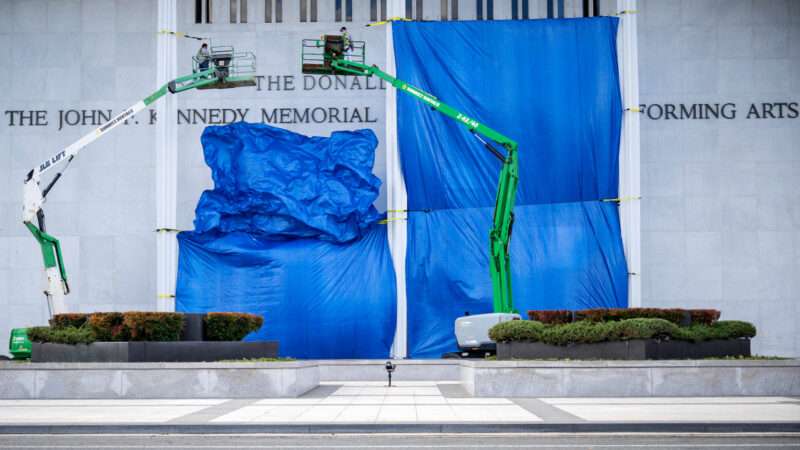
When President Donald Trump announced a takeover of the John F. Kennedy Center for the Performing Arts last year, he claimed to be fighting a specific sort of cultural rot at the Washington, D.C., institution. "We don't need woke at the Kennedy Center," he said in February 2025. "So I'll be there until such time as it gets to be running right."
The president abandoned that in May 2026, after a federal judge ruled that the center was illegally renamed after Trump. Trump's remedy for a "woke" Kennedy Center was to replace one alleged strain of political capture with another.
The center operates in a gray zone between the public and private sectors. Taxpayers fund building maintenance, operations, security, and repairs. Private donors and ticket sales, meanwhile, are the main source of money for programming. Originally known as the National Cultural Center, the venue was renamed by Congress in 1964 to honor President John F. Kennedy after his assassination. Memorials to former presidents are not unprecedented. Yet naming an arts institution after a politician was itself a political act, as was using taxpayer money to create it in the first place.
Trump is a singular character. But he has provided an example, however cartoonish, of what can happen when you give the public sector control over something that is inherently a private endeavor. The vast majority of Americans will never set foot inside the "national cultural center." Why are they paying for it? And why does someone like Trump have any say over it?
The takeover was predictably disastrous. Ticket sales plummeted, artists canceled performances en masse, and donations reportedly declined. "It is our desire to perform in our home at the Kennedy Center," Washington National Opera artistic director Francesca Zambello, who said donor confidence had "shattered," told The Guardian last year. "But if we cannot raise enough money, or sell enough tickets in there, we have to consider other options." The company left the Kennedy Center soon after.
In August 2025, at the height of the takeover, Parade arrived at the Kennedy Center. The musical tells the story of Leo Frank, a man whom historians widely agree was wrongly convicted of murder. After his death sentence was commuted to life in prison, he was lynched by vigilantes.
Parade was relocated to the center's Eisenhower Theater from its opera house, which is more than twice the size, amid weak ticket sales. The show is a powerful exploration of antisemitism, media malpractice, racial dynamics in the South, and tribalism—the type of complicated story that is tailor-made to transcend partisan fractures. At Trump's Kennedy Center, it played to a sparsely filled house.
The post Trump Said He Would Rid the Kennedy Center of 'Woke.' He Injected His Own Politics Instead. appeared first on Reason Magazine.